Books, essays, podcast episodes, and more that I think are worth your time, plus recent cultural news that I’m paying attention to in the month of June…
{Get my favorites delivered to your inbox each week. Subscribe here.}

Books
Non-Fiction: Braving the Wilderness by Brené Brown
I picked up this book because I read elsewhere that it is the “bible of belonging.” On the one hand, it’s a book about learning that we belong independent of what anyone else things (I would actually call that learning that we are beloved). On the other, it’s a book about belonging to one another and how we can experience that sense of belonging in our fragmented world. There’s more to it than this, but experiences of collective joy and sorrow (but not the experiences of collectively mocking or judging others) give us an experience of belonging to one another.
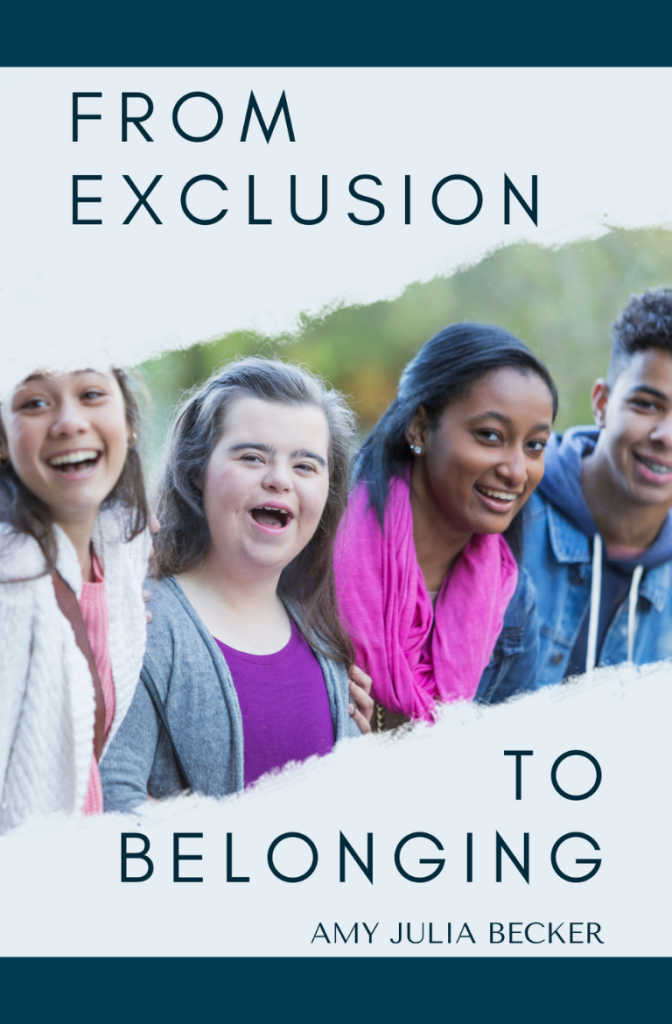
I also loved the distinction she makes between fitting in and belonging: “If I get to be me, I belong. If I have to be like you, I fit in.” I think about how impossible it often is for people with disabilities to fit in and how that impossibility closes doors for them. But if they are invited into a community of belonging, doors open not only for them but for everyone.
Podcast Episodes
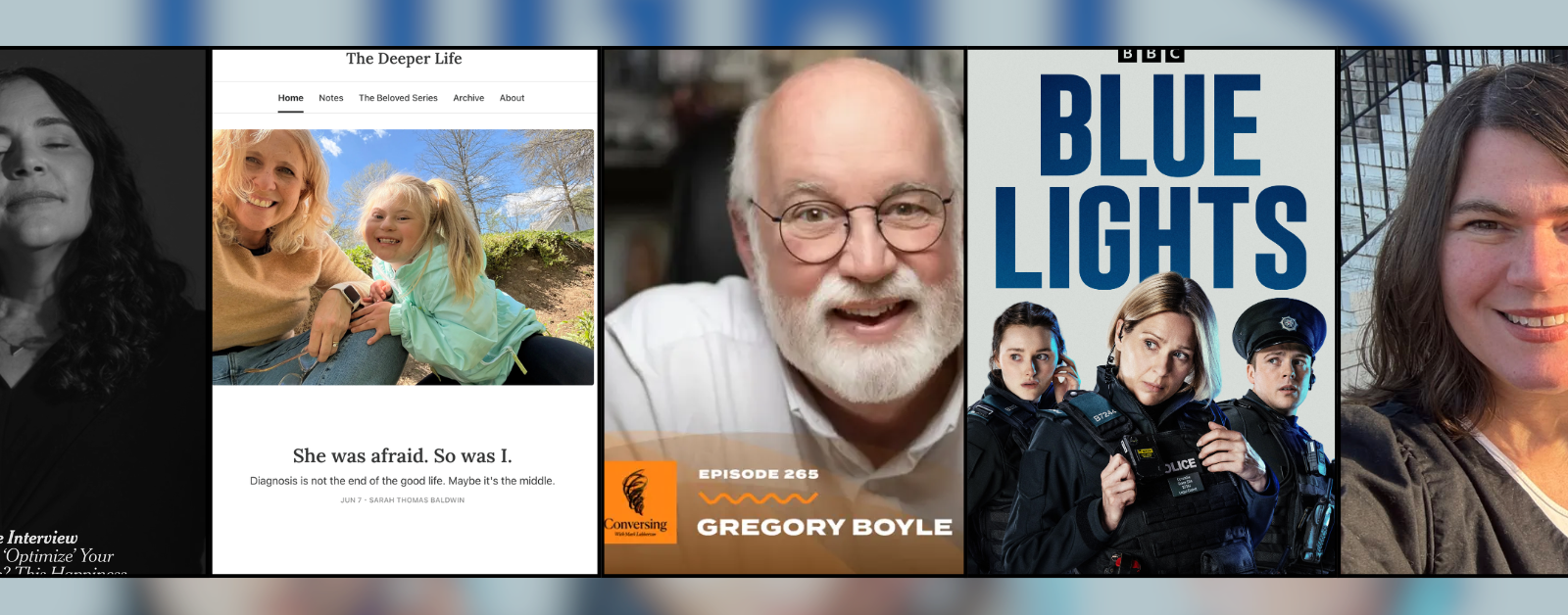
Conversing Podcast: Kinship and Gang Life, with Gregory Boyle
I could listen to Greg Boyle remind me of God’s tender compassion for each and every one of us all day long.
The Daily: Want to ‘Optimize’ Your Happiness? This Happiness Expert Says: Don’t.
As I referenced above, I loved Laurie Santos’ interview about happiness and being reminded of the difference between hedonic (personal pleasure) and eudaimonic (broader pursuit of “the good life” or holistic flourishing) happiness. I was fascinated to hear that, in general, the people who work to change structural problems are happy, not depressed. In other words, happiness leads us to care for others and seek to solve social problems, not become more self-obsessed or complacent about our social position.
Shows + Films
BritBox Drama: Blue Lights
Peter and I have been watching this crime drama set in Northern Ireland for a few months now. I’ve enjoyed it all along—the characters are interesting, the acting is great, and I’m curious about what’s going to happen next. But it wasn’t until the final episode of season two that I decided to recommend it to you all. I wasn’t sure if this was just an interesting, entertaining crime drama or if something else was going on. The season concludes with a meditation on justice, forgiveness, community, and—no surprise given the name of one of the main characters—grace.
Film: Pressure
We had a chance to tour the D-Day beaches in Normandy, France last March as a family, so we knew we wanted to see the film Pressure. It’s a drama set in the few days before D-Day as meteorologists debate whether or not the Allies should invade France. The fate of the world order hangs in the balance. It’s a drama that had all three of us (William, Marilee, and me) riveted throughout. I suspect this film will leave theaters soon, but if you have a chance, I’d recommend seeing it there asap.
Current Events
Current Stats About Down Syndrome
My friend Stephanie Meredith, DrPH, MA, is the Development Director at the Genetic Support Foundation (GSF). I want to share her post with you, in which she counters the misinformation in Jesse Ridgway’s post.
Essays
Christian Century: “The scars of a flourishing human”
This month, the Christian Century’s cover story, “The Scars of a Flourishing Human” by Aaron Brian Davis, explores disability and theology. Even though I’ve been learning about this topic for twenty years now, I always find more to consider. I especially appreciated Davis’ consideration of what the purpose of human life is. He writes about how the highest good any of us can obtain is union with God. “What people are for—their purpose as God’s creatures—is this union.” (That’s according to Aquinas). And then he asks, “But since bodies, and especially human bodies, are complex wholes rather than mere assemblages of parts, what if a departure from the blueprint actually helps them be in union with God?” I’ve often found that disability helps me see the places where I am asking the wrong questions, and Davis reminded me of this once again.
Substack: She was afraid. So was I.
I also really appreciated Sarah Thomas Baldwin’s reflections on her own journey through the “goodhard” experience raising a child with Down syndrome
Get my favorites delivered to your inbox each week.
Subscribe here.
More Favorites and AJB Recommends
If you use a link from here to purchase something I recommend, it sometimes earns me a small commission, which enables me to continue the work I do here. So thank you! (As an Amazon Associate, I earn from qualifying purchases.)
SUBSCRIBE to my Substack newsletter: amyjuliabecker.substack.com
JOIN the conversation on Instagram: @amyjuliabecker
LISTEN to my podcasts: amyjuliabecker.com/shows/
CONNECT on YouTube: Amy Julia Becker on YouTube
Amy Julia Becker desires to challenge assumptions about the good life, proclaim the inherent belovedness of every human being, and help us envision and build a world of belonging where everyone matters. Amy Julia invites people to reimagine the good life through her writing and speaking on disability, faith, and culture. She is the author of several books, including To Be Made Well, White Picket Fences, Small Talk, and A Good and Perfect Gift. She is a guest opinion writer for national publications and hosts two podcasts: Take the Next Step and Reimagining the Good Life. Becker is a graduate of Princeton University and Princeton Theological Seminary (MDiv). She is a member of the Disability Ministry Network and the Alliance for Disability Justice and Ethics in Reproductive Genetics. She lives with her husband and their three children in western Connecticut.