Books, essays, podcast episodes, and more that I think are worth your time, plus recent cultural news that I’m paying attention to in the month of November…
{Get my favorites delivered to your inbox each week. Subscribe here.}
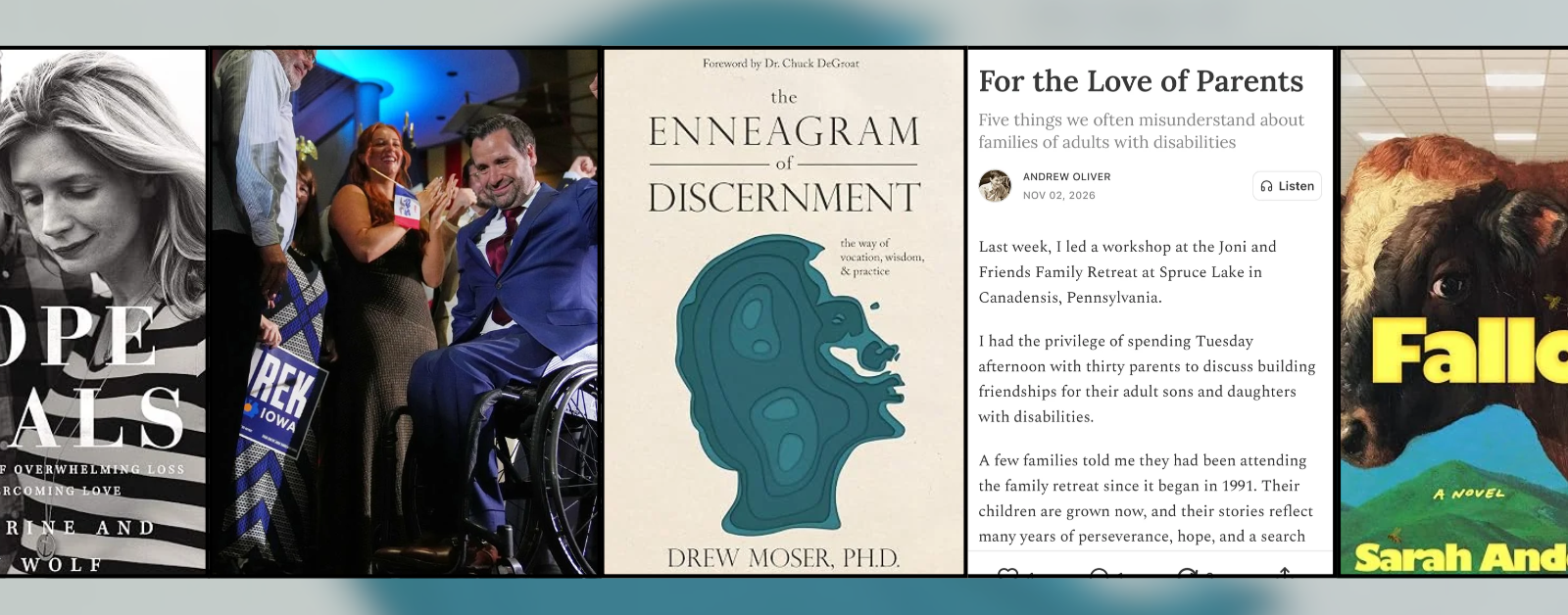
Substack: “For the Love of Parents” by Andrew Oliver
I deeply appreciated this essay from Andrew Oliver about what parents of adults with disabilities need from their communities. He offers wise observations about the situations many parents find themselves in, but he also offers a suggestion for how to make things better, by getting more people involved. Here’s where it gets interesting. Andrew writes:
“So how do we get more people involved? Not primarily from the top, through politicians and senior leaders. Not primarily from the bottom, through protest marches and social media campaigns. But somewhere much less exciting, yet far more sustaining. Change starts in the middle….” {Keep reading}

Disability Scoop: “Paralympic Champion With Spina Bifida Heading To Senate”
It’s so worth celebrating the work that was done over 50 years ago, first by advocates and later by politicians, to create the conditions that made it possible for people like Josh Turkek, who uses a wheelchair and has spina bifida, to become a Senator. And it’s doubly beautiful that Turek just won a Senate seat that had been held for 30 years by Tom Harkin, one of the most influential lawmakers in paving the way for people with disabilities to belong in public life.
Non-Fiction: The Enneagram of Discernment by Drew Moser
As an Enneagram One, I am always eager for instruction that can tell me how to get things done right, and this book did not disappoint! It was a great reminder of how I can give far too much weight to my inner critic, but also that I can listen to the voice of love. I need the balance of past, present, and future and the balance of head, heart, and body when making decisions about what is mine to do, and this book is full of helpful insights into how to live a more balanced way and make decisions accordingly. (Peter read it as well and found it very helpful as an Enneagram Three.)
Fiction: Fallow by Sarah Anderson
Has anyone else read this book? If you have, please let me know because I’d like to talk to someone about it! The premise is that a young woman gets hired by The Company to become a surrogate mother. She agrees to 9 rounds of pregnancy, each for a different member of The Company, so that said workers can keep working without slowing down their productivity or bodily needs during pregnancy. It’s a very compelling story that prompts reflection on our world of disembodied relationships, corporate commitments to empowering women while maintaining capitalist values of productivity at all costs, and on what it means to be human.
Movie: 13 Going on 30
Somehow, I missed the movie 13 Going on 30 when it first came out, but I found it thoroughly enjoyable to watch with Penny last weekend. As an almost-21-year-old, Penny is smack in the middle of the two ages represented in the movie, and I loved thinking about all the growing up she’s done in the past 8 years and what’s ahead in the decades to come. It was fun, sweet, and funny and made me think about how we can make choices now to become the people we want to be decades from now.
The GoodHard Story podcast: Feeling Spiritually Homeless with Mike Erre
I could listen to Katherine Wolf and Mike Erre all day long. Yes, this is a great conversation related to disability, and it also is a great conversation about spiritual formation and growth in the midst of a religious landscape that often feels broken and exclusionary.
Memoir: Hope Heals by Katherine and Jay Wolf
Penny and I just finished reading Hope Heals, Jay and Katherine Wolf’s first book about Katherine’s sudden brain stem stroke at the age of 26 that left her seriously impaired on one side of her body. It was incredible to revisit this story after reading it a decade ago, and this time with Penny reading it out loud to me. What a testimony to what Katherine has come to call her “goodhard story,” to the presence of God even amidst the most horrific events of our lives, and to the power of love to heal.
Non-Fiction: Who You’re Becoming by Chuck DeGroat
This book feels like an essential guidebook for anyone who wants to mature as an adult. Degroat takes us through so many ways of knowing ourselves, facing our false selves, and understanding what keeps us from becoming who we are created to be—it’s like a gentle but clear therapy session with practical exercises and reflections with every chapter. I highly recommend this book for anyone who wants to know themselves better and live in love.
Memoir: Sitting Pretty by Rebekah Taussig
I just reread Sitting Pretty (in preparation for an interview with Rebekah Taussig about her role writing the screenplay for Being Heumann), and it was just so good. Taussig is a fantastic writer—funny, smart, vulnerable, strong. And I love learning a lot about a topic through a memoir. We get Taussig’s own story of growing up as the youngest child in a big family and as someone who uses a wheelchair to navigate the world. She does an incredible job of naming why it matters to all humans that we pay attention to ableism:
“Because the disabled body is most powerfully by affected ableism, it is the first to cast a light on the structure, to resist and protest it, to call for its public execution, but we’re all living under its dictates. Ableism punishes all of us. In its most boiled-down, squished together, simplified form, ableism is the process of favoring, fetishizing, and building the world around a mostly imagined, idealized body while discriminating against those bodies perceived to move, see, hear, process, operate, look, or need differently from that vision.”
Get my favorites delivered to your inbox each week.
Subscribe here.
More Favorites and AJB Recommends
If you use a link from here to purchase something I recommend, it sometimes earns me a small commission, which enables me to continue the work I do here. So thank you! (As an Amazon Associate, I earn from qualifying purchases.)
SUBSCRIBE to my Substack newsletter: amyjuliabecker.substack.com
JOIN the conversation on Instagram: @amyjuliabecker
LISTEN to my podcasts: amyjuliabecker.com/shows/
CONNECT on YouTube: Amy Julia Becker on YouTube
Amy Julia Becker desires to challenge assumptions about the good life, proclaim the inherent belovedness of every human being, and help us envision and build a world of belonging where everyone matters. Amy Julia invites people to reimagine the good life through her writing and speaking on disability, faith, and culture. She is the author of several books, including To Be Made Well, White Picket Fences, Small Talk, and A Good and Perfect Gift. She is a guest opinion writer for national publications and hosts two podcasts: Take the Next Step and Reimagining the Good Life. Becker is a graduate of Princeton University and Princeton Theological Seminary (MDiv). She is a member of the Disability Ministry Network and the Alliance for Disability Justice and Ethics in Reproductive Genetics. She lives with her husband and their three children in western Connecticut.