Books, essays, podcast episodes, and more that I think are worth your time, plus recent cultural news that I’m paying attention to in the month of October…
{Get my favorites delivered to your inbox each week. Subscribe here.}
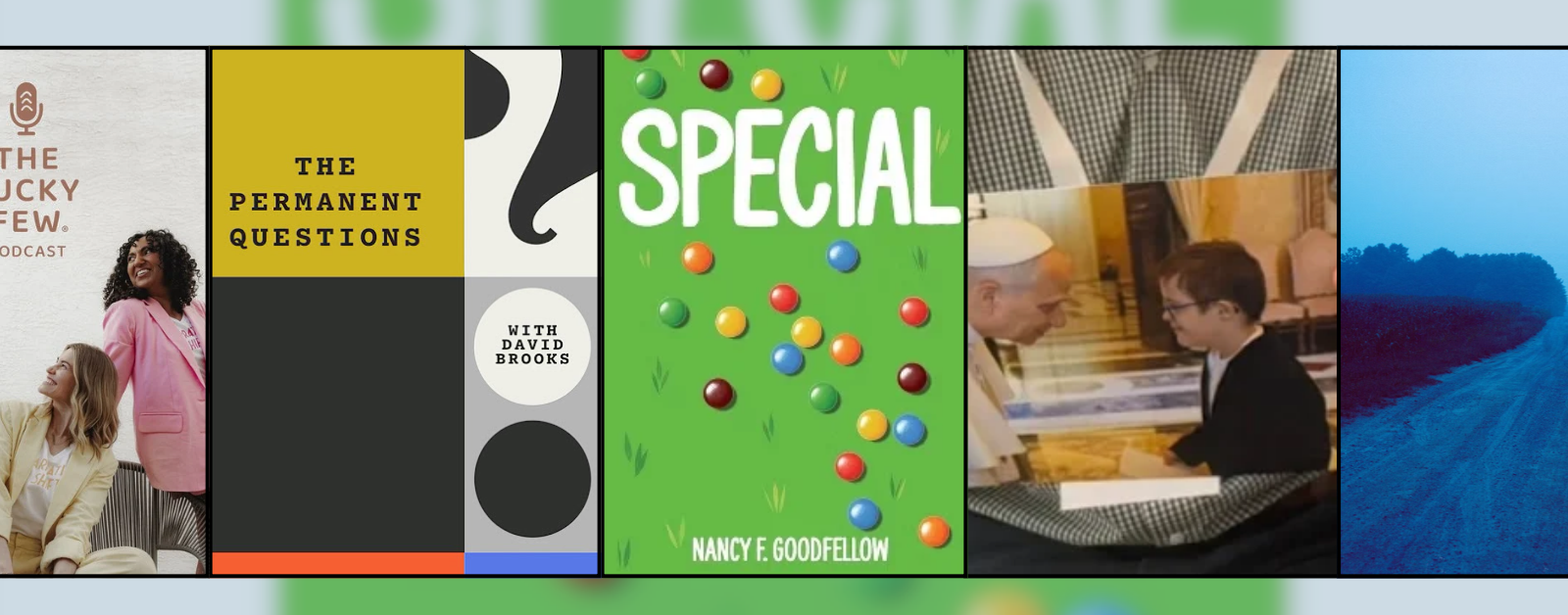
The Permanent Questions: “Should We Ban AI for Kids?‘“
This whole conversation between Jonathan Haidt and David Brooks was fascinating, but I was especially struck by the thought that one way AI degrades civilization and humanity is by taking care of our needs. In Haidt’s words:
“One of the most profound effects that I think [AI’s] going to have, it’s already having, is that we don’t need each other as much. And if you have a civilization where people don’t need each other, lots of bad things are going to happen. To the extent that people need each other, that you get really high social capital, trust, interaction, people build institutions together.”
As I’ve said over and over again, it is a positive feature, not a bug, of our humanity that we need one another.

Participation and Hope in the Midterms
We are entering the midterm election cycle, so politics is front and center and hard to avoid. If you are looking for some ideas and conversations that rise above the fray of this particular political moment while reminding us of the significance of our participation in the political cycle and even offer some hope for it—these episodes of Reimagining the Good Life are worth your time:
- The Myth of a Colorblind, Meritocratic Society with David M. Bailey
- How to Be Christian During Election Season with Corey Widmer
- When Your Church and Political Group Turn on You with Nancy French
- Healing the Harm of White Evangelicalism with Kristin Du Mez
- American Politics, Power, and Human Flourishing with Andy Crouch
The Lucky Few: What to Really Be Aware of This Down Syndrome Awareness Month
I’m really appreciating The Lucky Few podcast in the midst of Down Syndrome Awareness month. This episode was a great conversation about why the accomplishments of people with Down syndrome needed to be celebrated and highlighted as a part of early advocacy efforts, and why that emphasis on accomplishment can turn problematic in the end.
The Atlantic: What If AI Is the End of the World?
I hope and pray that our age of AI opens up new things—for us as humans to imagine new possibilities and new ways of loving and caring for one another in our physical bodies and in real (not artificial) ways. Peter Wehner has much of significance to say about AI and humanity in this essay, and I love that he also brings up Christian hope here:
“Revelation is hardly a favorite book of mine except for this: In the 21st chapter, we read that “there will be no more death or mourning or crying or pain, for the old order of things has passed away.” And God promises, “Behold, I make all things new.”
I have cited those words to others, and to myself, more times than I can count. It is not a promise that the current world won’t end—after all, many New Testament writers believed that they were living in the end times—but rather that the world will then be renewed. The old order will give way to a new one, where creation is healed and justice is restored and God will ultimately reconcile every creature to himself.
Skeptics of Christianity will say this is wishful thinking, and perhaps it is. But wanting something to be true doesn’t make it false. Wishful thinking, tethered to reality, is another name for hope. Sometimes hope is all we have, and sometimes hope is enough.”
New York Times: “We Implemented Canada’s Assisted Dying Law. We’re Concerned.”
People will choose to die when they are suffering if given the option. But what about the suffering that comes as a result of our social environment and the meaning we make of our lives? These physicians support medical assistance in dying, and they are still gravely concerned about how that law is being implemented:
“We’ve seen how beneficial it is to pause and reflect with our own patients. One of them, a woman in her 70s, was the matriarch of her family, the one who made Sunday dinners. She sought and received approval for assisted dying after she lost the ability to cook. She felt she had lost her value to her family. Through counseling, she came to understand that her family valued who she was, not what she did for them. She decided not to go through with ending her life, at least for now. That Christmas, her family gathered and she sat proudly at the table, while others did the cooking and serving.”
Episode 417: Helping Families with Disabilities Experience Their Capability
I was so grateful to talk with Sissy Goff and David Thomas on the Raising Boys and Girls podcast. Measuring kids against developmental milestones often makes children with disabilities look incapable. I describe how to let love “wrap around” fear and help kids feel wanted, valued, and needed. (Plus I share how we turned 12-year-old Penny’s dream of living with friends in Chicago into “Mondays, Penny does her own laundry.”)
The Ezra Klein Show: “Is the World Getting Uglier?”
I’ve had a number of conversations lately about beauty, and this episode of Ezra Klein’s podcast does a great job of articulating why beauty matters. I hadn’t ever thought about the distinction between beauty and ugliness and vulgarity or about the ways efficiency can diminish beauty, so I was grateful to be given ways to see and think about the visual world.
Aleteia: “When 6 altar servers with Down syndrome take on a papal Mass”
There are lots of reasons to distrust the church—whether Catholic or Protestant. And then there are also lots of reasons to celebrate everything about a place that recognizes not only the inherent belovedness and dignity of every human but also the contributions everyone can make to the community. I love this story of six young men with Down syndrome who served mass FOR THE POPE in Paris recently.
“The six young men around the altar did not need to prove that worth by being useful, of course, but their presence offered another reminder of what respecting human dignity can look like in practice. It is not simply a matter of making room for somebody; it is also noticing their talents, trusting them and sometimes allowing them to be the person who knows what to do.”
Middle-School Fiction: Special by Nancy Goodfellow
I’ve been on the search for a middle-grade book that portrays a young girl with Down syndrome as a fully realized character for many years. I wrote about this struggle for TIME (Where are all the children’s books featuring kids with Down syndrome?), and I would like to add a postscript to that essay. I’ve finally found the book I’ve been looking for: Special, by Nancy Goodfellow. {Keep reading}

New York Times: “I’m Exhausted. You’re Demoralized. We Weren’t Built for a World Like This.”
Bill McKibben wrote a final line in an essay recently that caught my attention:
“We’re creating a world that’s only fit for something artificial.”
He summed up something I’ve been thinking about—the fast pace of our world, the impending sense of doom over AI and politics and the climate, and the disconnections we feel. It all begs us to turn our attention—which is to say our time, our energy, our love—toward the human. Toward ourselves in our embodied, needy, beautiful humanity. Toward the humans all around us in their messy, imperfect, goodness. Toward slowing down and showing up.
The Happiness Lab: “Why Smaller Goals Can Lead to Bigger Changes with Eric Zimmer”
This conversation made me think about the idea of just taking “the next step.” Rather than setting big (aka unachievable goals), Eric Zimmer talks with Dr. Laurie Santos about the way small changes and small steps can make a big difference in changing our everyday lives.
Radiolab: “Why Isn’t the Sky Blue?”
Okay, this is really wild. Apparently, ancient civilizations didn’t see the color blue. I’m still trying to understand what I even mean when I write that sentence, and also what it means for us in terms of how we perceive reality, but if you’re interested in learning with me, here’s the episode of Radiolab that got me thinking about it.
TV Series: Ted Lasso
And while I don’t think it’s as great as the other seasons, we’re still enjoying season four of Ted Lasso. Penny says it is the best season ever, so there’s that.
Get my favorites delivered to your inbox each week.
Subscribe here.
More Favorites and AJB Recommends
If you use a link from here to purchase something I recommend, it sometimes earns me a small commission, which enables me to continue the work I do here. So thank you! (As an Amazon Associate, I earn from qualifying purchases.)
SUBSCRIBE to my Substack newsletter: amyjuliabecker.substack.com
JOIN the conversation on Instagram: @amyjuliabecker
LISTEN to my podcasts: amyjuliabecker.com/shows/
CONNECT on YouTube: Amy Julia Becker on YouTube
Amy Julia Becker desires to challenge assumptions about the good life, proclaim the inherent belovedness of every human being, and help us envision and build a world of belonging where everyone matters. Amy Julia invites people to reimagine the good life through her writing and speaking on disability, faith, and culture. She is the author of several books, including To Be Made Well, White Picket Fences, Small Talk, and A Good and Perfect Gift. She is a guest opinion writer for national publications and hosts two podcasts: Take the Next Step and Reimagining the Good Life. Becker is a graduate of Princeton University and Princeton Theological Seminary (MDiv). She is a member of the Disability Ministry Network and the Alliance for Disability Justice and Ethics in Reproductive Genetics. She lives with her husband and their three children in western Connecticut.