Books, essays, podcast episodes, and more that I think are worth your time, plus recent cultural news that I’m paying attention to in the month of January…

ESSAYS
New York Times: The ‘R-Word’ Returns, Dismaying Those Who Fought to Oust It. (Gift article link)
I wish there wasn’t more to share about the resurgence of the r-word, but here it is again. We can use language to lift people up or to put people down. Whatever you think about the r-word, using it does not lift anyone up.
“For decades now, the “R-word” has been regarded as a slur against people with intellectual disabilities — a word to be avoided. Yet it has had a striking resurgence, in part because people in high-profile positions of power and influence have chosen to resurrect it, often with an air of defiance.”

“The Kingdom of God Is Ruled by the Humblest of Men.”
Lovely (and challenging) article by Peter Wehner on the reason to pay attention to the babe in the manger…
The moral teachings of Jesus, the way he modeled loving others, are compelling not because they are countercultural, though they are, but because they are intrinsic. What God attributes worth to is something we ought to attribute worth to. That applies to moral truths and human beings, including, and maybe especially, those whom Jesus called “the least of these.”
BOOKS
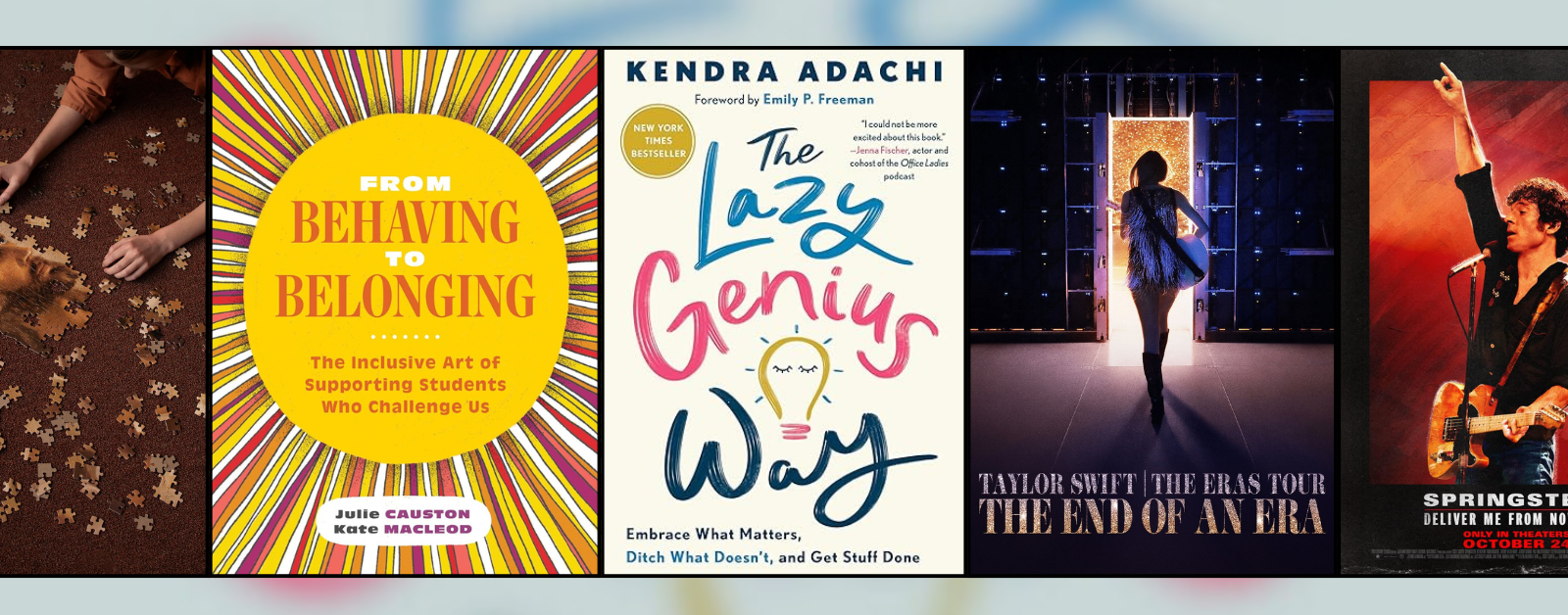
The Lazy Genius Way by Kendra Adachi. If you have New Year’s resolutions around time management or household clutter, this book is for you. Honestly, even if you don’t believe in New Year’s resolutions but you’d like some simple and life-giving advice about how to bring some order to the chaotic corners of your life, this book is a great place to start. Thank you to one of you for sending it my way as I think about meaningful and manageable ways to help families affected by disability.
From Behaving to Belonging by Julie Causton and Kate MacLeod. This is a practical and accessible book specifically designed for classroom teachers who want to cultivate inclusive classrooms where everyone belongs and no one is designated a “bad kid” or a problem. That said, it’s helpful to me as a parent too—I only wish I had read it as a parent of younger kids.
FILMS AND SHOWS
Springsteen: Deliver Me from Nowhere.
This Bruce Springsteen biopic rocked me. It was so much more than a cool story about how a kid from New Jersey became an international rock star. It tapped into something deeper, and darker, about our humanity than the typical film like this one. This is a movie about growing up, and discovering who we are, and the power of art and friendship and human connection to lead us toward the light.
The End of an Era. Okay, so I didn’t expect to love The End of an Era, Taylor Swift’s six-part documentary about the making of the Era’s Tour. But it was great. I would have watched 20 more episodes. There’s so much to say about the way this whole production was put together and executed, but what struck me most of all was how the film—and the tour itself—centered around elevating others. It is easy for me to get cynical about Taylor Swift and her megastardom. But this series felt like watching her use that stardom to lift other people up—whether that’s the truck drivers who received a $100,000 bonus or the kids who experienced a one-on-one moment with her in the middle of each show or the dancers who didn’t fit conventional body type norms but were hired to perform because of their incredible skill and energy or considering how to delight the millions of fans who follow her every move. Our whole family enjoyed this series together.
The Pitt. Apparently, I am the only one in my family drawn to medical dramas. I was an ER devotee back in the day, and I have finally discovered The Pitt. It’s a critically-acclaimed show, set in an ER over the course of one day (each episode follows the doctors and nurses through one hour of their day, more or less in real time). But there are lots of critically acclaimed and/or popular shows I just can’t stomach. I didn’t make it through Succession, or Yellowstone, or White Lotus, or Your Friends and Neighbors. They all seemed too dark, with no hope for redemption. Sophie Gilbert, writing about The Pitt for the Atlantic, explains:
“The Pitt has an emphatic moral clarity that feels awkward only because we haven’t seen it for so long. It refuses to both-sides issues that it considers straightforward. Should you vaccinate your children against measles? Yes, The Pitt says, offering up a child with not just spots all over his body but also acute inflammation in his brain and spinal cord. The show is set in the emergency room, where society’s problems become inescapable, where people who have fallen through the cracks land. In an era of relentlessly absurd and wealth-washed TV, The Pitt’s realism, its defiant lack of glamour, is bracing.”
I, for one, am ready for some moral clarity and heroic deeds all offered through very vulnerable and needy humans.
Knives Out: Wake Up Dead Man. This movie—the third in the series—was a little over-the-top for me, but I’m still mentioning it because I was so fascinated to watch a film portray the transformative grace of Christianity in such clear and unflinching terms. I’ll defer to Ross Douthat’s comments about it by way of recommendation. Douthat explains,
“Johnson, a non-Catholic director, sets out to tell a story about religion using familiar post-1960s tropes — pitting an intolerant, puritanical form of Christianity, associated with the older generation (embodied by Josh Brolin’s ranting Monsignor Jefferson Wicks), against a gentler, more merciful form associated with youth (embodied by Josh O’Connor’s Father Jud Duplenticy).”
And then he writes, “But the portrait of Father Jud, crucially, is not the secularized or therapeutic vision of Christian ministry that predominated in some liberal circles after Vatican II, and it’s certainly not a vision that suggests that the traditional priestly vocation is somehow obsolete. No: What Johnson, the strident political liberal, seems to want from his virtuous, non-MAGA Christian cleric is a sacramental and mystical vocation, carrying with it the special capacity to hear confessions and forgive sins, to bind and loose. In my experience, this impulse is common among younger religious believers, Catholic or otherwise, who are alienated from Christianity’s Republican or Trumpian expressions: They may want a more liberal form of religion, but they don’t want a more secularized form, and they’re much more interested in the mystical and sacramental than their 1970s antecedents were.”
So even though I didn’t love the film, it was good enough, and I did love this prompt to consider how and why young believers (in this case, myself included, even though I am decidedly middle-aged) are turning away from harsh and dogmatic expressions of faith, not toward secularism but toward a different experience and expression of Christianity. I wonder whether we’re finding that our secular world is just as harsh and dogmatic as the religious one. If we are longing for grace, then the contemplative and mystical Christian path might be the one that can carry us home.
NEWS
Autistic Barbie.
In the past seven years, Mattel has released a whole series of Barbies with various disabilities and health conditions.3 The most recent one is autistic Barbie. If you’re interested in the ways Mattel chose to visibly represent autism, this article from the Guardian gives a good summary. And this essay in TIME gives a great defense—from the perspective of a woman with autism—of the choices Mattel made in creating this doll.
“Student-Run Cafes And Shops Give Teenagers Real-World Job Skills.” I have often felt uncomfortable with work programs for students with disabilities in schools. Penny, for example, restocked shelves in the cafeteria in her high school. On the one hand, she was learning real-life skills that could transfer to a workplace. On the other hand, she was doing unpaid work that served the general education students and seemed to reinforce a social hierarchy.
So I loved reading this report about students all over the country in school-based workplaces that employ teenagers with disabilities alongside their general education peers. These are examples of students creating real businesses within their schools and learning how to work together, how to think entrepreneurially and creatively, and gaining some income (or raising money for charity) along the way.
It’s one more encouraging indication of a mindset shift that sees the ways people with disabilities matter and belong within their communities.
Get my favorites delivered to your inbox each week.
Subscribe here.
More Favorites and AJB Recommends
If you use a link from here to purchase something I recommend, it sometimes earns me a small commission, which enables me to continue the work I do here. So thank you! (As an Amazon Associate, I earn from qualifying purchases.)
SUBSCRIBE to my Substack newsletter: amyjuliabecker.substack.com
JOIN the conversation on Instagram: @amyjuliabecker
LISTEN to my podcasts: amyjuliabecker.com/shows/
CONNECT on YouTube: Amy Julia Becker on YouTube