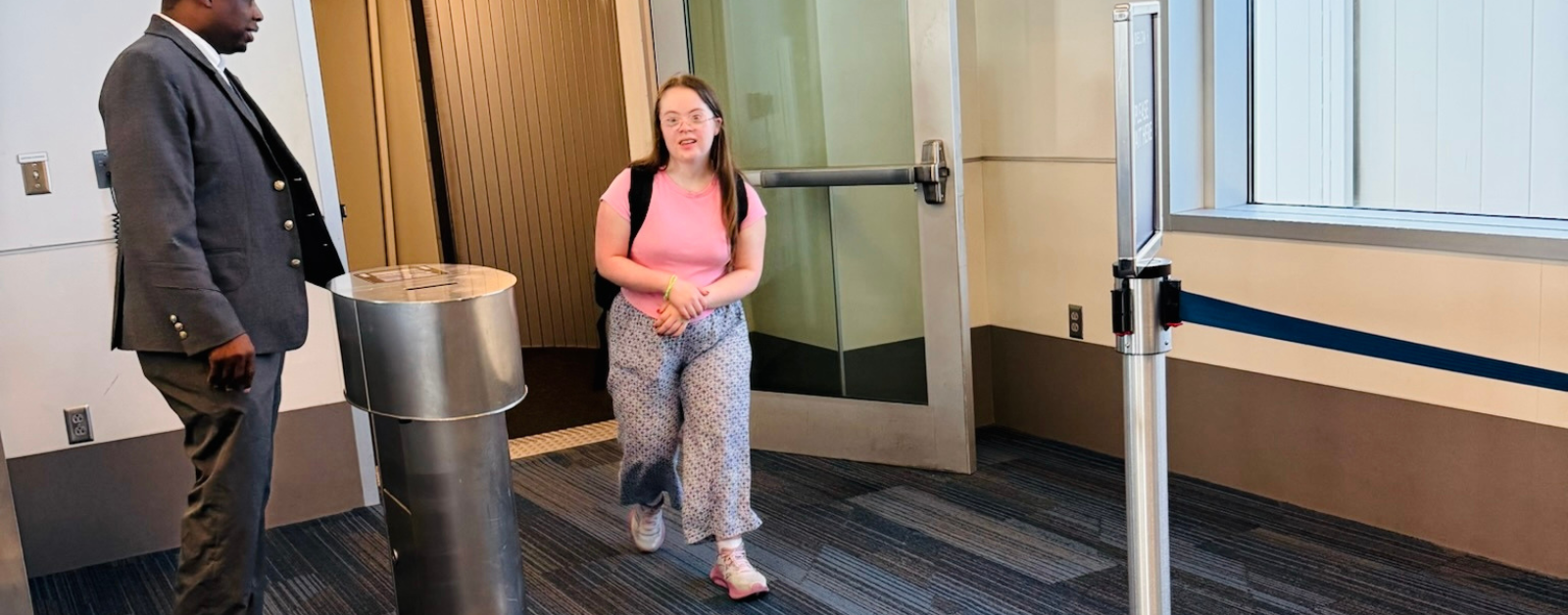
How do you prepare for a solo flight with Down syndrome? When someone with Down syndrome flies independently for the first time, families often have a lot of questions: How do you navigate security? What support is available? What should you prepare ahead of time?
As we prepared for Penny’s first solo flight with Delta Air Lines, we received an outpouring of advice and support from fellow parents. We asked Chat GPT to take ALL these comments and distill them for us so that we can pass along what we learned to our fellow travelers. Here’s the bottom line: Use every support available (gate passes, TSA Cares, disability assistance, and a pickup at the gate), and spend most of your preparation time planning for unexpected delays or cancellations rather than for the flight itself.
1. Get Gate Passes So Someone Can Escort Penny to/from the Gate
People repeatedly advised:
- Walk her all the way to the departure gate.
- Have someone meet her at the arrival gate.
- Stay until the plane actually takes off.
- Have the pickup person wait at the gate when she lands.
Many commenters shared stories of delays, cancellations, gate changes, or airline staff not following through, and said gate passes provided peace of mind and a safety net.
“Take her to the gate, and have someone meet her at the gate.”
2. Plan for Delays, Cancellations, and Other Disruptions
Second most common theme.
Many people said:
- The flight itself isn’t the biggest concern.
- The biggest challenges happen when plans change.
- Have a clear backup plan.
- Discuss what Penny should do if a flight is delayed, canceled, or redirected.
Several commenters shared stories of airline assistance breaking down when weather or scheduling issues arose.
“The problem isn’t the flight—it’s what happens when the flight doesn’t go as planned.”
3. Use Disability Assistance Services (Especially TSA Cares)
People repeatedly recommended:
- TSA Cares
- Airport accessibility offices
- Airline disability assistance teams
Several commenters described receiving:
- Dedicated assistance through security
- Shorter lines
- Personal escorts
- Extra support navigating airports
“TSA Cares is an incredible resource.”
4. Request Wheelchair Assistance (Even If She Doesn’t Need a Wheelchair)
This came up more often than expected. The rationale was navigation and accompaniment, not so much mobility. Commenters noted that wheelchair assistance often means:
- A dedicated airport employee
- Help with gate changes
- Help navigating large terminals
- Someone responsible for getting the traveler where they need to go
“Request wheelchair service so someone is assigned to get her through the airport.”
5. Use a Sunflower Lanyard
A recurring recommendation from families of people with invisible disabilities. People said the lanyard:
- Signals to airport staff that extra support may be helpful.
- Often leads to more proactive assistance.
- Is widely recognized in many airports.
“Airport staff immediately understood and were incredibly gracious.”
6. Put AirTags on Everything
A practical suggestion that appeared multiple times.
Recommendations included:
- AirTag in luggage
- AirTag in personal item
- Some implied keeping one on the traveler as well
The motivation was peace of mind rather than fear.
7. Create a Written Travel Packet
Several parents described making:
- Printed itinerary
- Airport maps
- Emergency phone numbers
- Backup contacts
- Step-by-step instructions
Commenters said that even if it wasn’t needed, having it reduced anxiety.
8. Practice or Familiarization Programs
People mentioned:
- Airport practice days
- “Wings for Autism” programs
- Mock security and boarding experiences
These allow travelers to rehearse the airport process before travel day. For several years, Penny has practiced going through security by herself when our family travels.
Do you have other tips for traveling with disability? Leave me a comment!
- SUBSCRIBE to my Substack newsletter: amyjuliabecker.substack.com
- JOIN the conversation on Instagram: @amyjuliabecker
- LISTEN to my podcasts: amyjuliabecker.com/shows/
- CONNECT on YouTube: Amy Julia Becker on YouTube
Amy Julia Becker desires to challenge assumptions about the good life, proclaim the inherent belovedness of every human being, and help us envision and build a world of belonging where everyone matters. Amy Julia invites people to reimagine the good life through her writing and speaking on disability, faith, and culture. She is the author of several books, including To Be Made Well, White Picket Fences, Small Talk, and A Good and Perfect Gift. She is a guest opinion writer for national publications and hosts two podcasts: Take the Next Step and Reimagining the Good Life. Becker is a graduate of Princeton University and Princeton Theological Seminary (MDiv). She is a member of the Disability Ministry Network and the Alliance for Disability Justice and Ethics in Reproductive Genetics. She lives with her husband and their three children in western Connecticut.