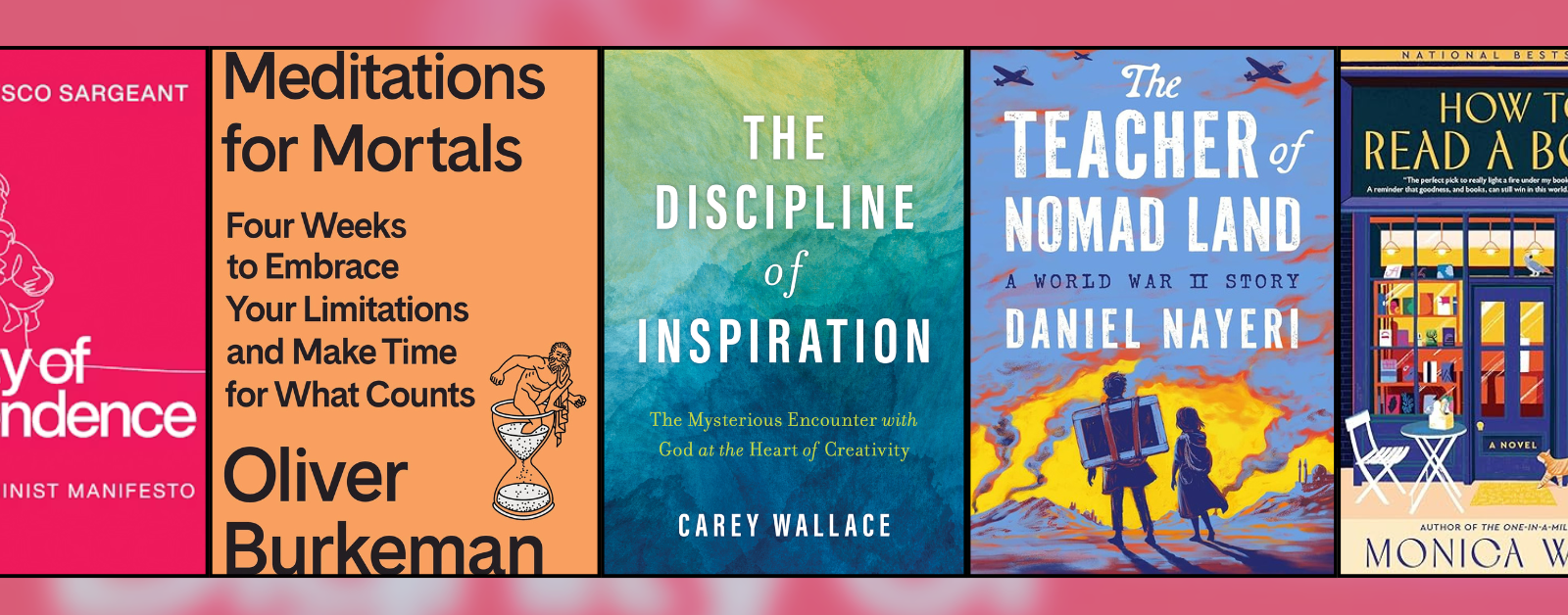
Here are books I loved in 2025.
Non-Fiction
The Discipline of Inspiration by Carey Wallace. Everyone is an artist, and all art is from God. I’m having trouble putting my recommendation for this book into words because it is both so interesting and so profound. Carey Wallace weaves together her own insights as an artist, research on artists like Prince and Toni Morrison and Picasso and so many more, with encouragement to practice disciplines that allow inspiration to arrive in our lives.
Meditations for Mortals by Oliver Burkeman
“We… feel that we need to get things done not only to achieve certain ends, or to meet our basic responsibilities to others, but because it’s a cosmic debt we’ve somehow incurred in exchange for being alive.”
Oliver Burkeman’s Meditations for Mortals is a beautiful reminder that accepting our limits as humans opens up so many possibilities for humility, love, and grace.
The Gardener and the Carpenter by Alison Gopnik. The premise of this book is simple: parents aren’t carpenters who construct their children into finished and predictable products. Rather, we are gardeners who help create conditions for ongoing growth and flourishing that is unpredictable and beautiful and based on love. Despite the simplicity, Gopnik does a wonderful job of exploring why it matters that we behave as gardeners, not carpenters, how we can change our approach to being a parent (she doesn’t believe in using parent as a verb), and how our entire society needs a reorientation if we are going to thrive.
Dirtbag Billionaire by David Gelles. This book about Patagonia founder Yvon Chouinard is intriguing and well-written, but what I loved most about it was the example of someone who is neither giving in to cultural norms nor completely distancing himself from our culture. Patagonia is a huge company that wants to help address all sorts of ecological problems. It also contributes to those problems simply by producing and selling. Chouinard holds onto his values and ideals, and he compromises those along the way. He, and his company, aren’t perfect, but they are seeking to do good. This story pushes me to think about ways I can do the same.
The Dignity of Dependence by Leah Libresco Sargeant. This book explores two interrelated themes. One, the ways in which this world is “not made for women,” as evidenced by things like airbags in car or kitchen countertops designed for the height/weight of average men. And two, the even deeper way in which this world is not made for us as dependent humans. Sargeant contends that the imaginary “normal” person in our society is a single white man in his late thirties. Everyone else (which is to say, almost all of us) deviates from that norm in what is seen as a problematic way of existence. Her book challenges us to reclaim dependence as a constitutive and good state of being human and to then imagine and enact a world that acknowledges this central truth. (You can listen to our conversation here.)
The Hospitality of Need by Kevan Chandler and Tommy Shelton. Kevan Chandler lives with spinal muscular atrophy, so he uses a wheelchair to navigate the world. He tells the story of admitting his own need and recognizing how that need can serve as a way to welcome others in need. Kevan’s friends have cared for him in ways most of us fail to imagine. They arrange their schedules to help him use the toilet, bathe, eat, and travel (including a two-week trip to Europe without his wheelchair).
Kevan reflects beautifully on the universality of need as well as the universality of being ones who are needed. He writes:
“Needs shake us, whether they belong to us or to someone else. If we’re in proximity, they can change us. They can cause us–force us–to slow down or keep up, to think and act differently from our norm. They can pull us out of our comfort zones and disrupt the ideal rhythms by which we usually function. They can either set right the broken or break the too-perfect.”
Listen in to my conversations with Kevan: “Christmas and the Hospitality of Need” on Reimagining the Good Life and “The Hospitality of Need: Disability and Interdependence” on Take the Next Step.
Life, Animated by Ron Suskind. Journalist Ron Suskind tells the story of his son Owen, who was diagnosed with autism at the age of three, his 2016 book Life, Animated. Their journey to connect to Owen and provide the support Owen needs to learn and have friends and work springs from Owen’s love of Disney. Instead of focusing on Owen’s deficits and all the ways he deviates from typical kids, they leaned into and celebrated what he loved most. Disney became the language through which they could understand and support Owen, and through which Owen could express his love in return. Suskind is a Pulitzer-prize winner, and he connects his tremendous writing skill and his deep love of his family together to tell a story of honesty and hope.
The End of Average by Todd Rose. This fascinating book explains why there is no such thing as an average person. It also explains how the idea of averages came to rule our schools and workplaces, how we began to understand some people as “better than” and “worse than” average, and how we can instead begin to value individuals for who they are and what they bring rather than needing them to conform to an illusory idea of average.

Fiction
True Biz by Sara Novic. I enjoyed the story and learned a lot while reading this novel set in a boarding school for the Deaf. I didn’t know, for example, that ASL (American Sign Language) is exactly that: American Sign Language. In other words, Deaf members of other cultures have developed their own sign languages too. I’m kind of amazed by my ignorance about facts like this one, as well as the history of Deaf culture in the United States. The characters and plot are interesting and keep the book moving, but I also loved being invited into a different way of being in the world and learning so much.
Orbital by Samantha Harvey. Orbital is a short, beautiful novel about six astronauts aboard the International Space Station. It takes place over the course of one day as they spin around our globe. I loved learning the science and technology bits even as it also prompted so much reflection on what it means to be human in relationship with each other and the earth.
How to Read a Book: A Novel by Monica Wood. One of you recommended this to me, and I loved it, so thank you! (I’ve also recommended it to multiple others, who have shared my enthusiasm.) It tells the story of a women’s book club—in prison. You can probably imagine the humanity that comes forth in this setting, so I won’t say anything more except to commend this book as a sweet, thoughtful story about reckoning with our mistakes and bad choices and living with hope and forgiveness.
Tell Me Everything by Elizabeth Strout. This novel is my favorite of Strout’s that I’ve read so far, telling the story of very ordinary people living ordinary lives of care and selfishness and love and pain in a lovely but also rather ordinary town in Maine.
Young Adult Fiction
The Teacher of Nomad Land by Daniel Nayeri. This National Book Award winning novel tells the story of a brother and sister making their way through the mountains of Iran during World War Two. It is tender and riveting and also opened my eyes to a piece of world history I’ve never known much about in the past.
Fahrenheit 451: Marilee prompted me to reread Fahrenheit 451, Ray Bradbury’s novel from 1950 that anticipates so much of our culture today. The book is eerily prescient, with people absorbed by screens, listening to their own soundtrack through little devices in their ears, disconnected from one another and depressed as a result. It also holds out hope for the power of ideas and the beauty of stories.
Get my favorites delivered to your inbox each week.
Subscribe here.
More Favorites and AJB Recommends
If you use a link from here to purchase something I recommend, it sometimes earns me a small commission, which enables me to continue the work I do here. So thank you! (As an Amazon Associate, I earn from qualifying purchases.)
SUBSCRIBE to my Substack newsletter: amyjuliabecker.substack.com
JOIN the conversation on Instagram: @amyjuliabecker
LISTEN to my podcasts: amyjuliabecker.com/shows/
CONNECT on YouTube: Amy Julia Becker on YouTube