I woke up from a Sunday afternoon nap and heard the washer going. It turned out Penny had decided to do laundry. She’s been capable of doing laundry for years, but I can’t remember a time where she washed her clothes without any prompting. That same afternoon, I received a photo from William in a green Halloween mask alongside four other people.
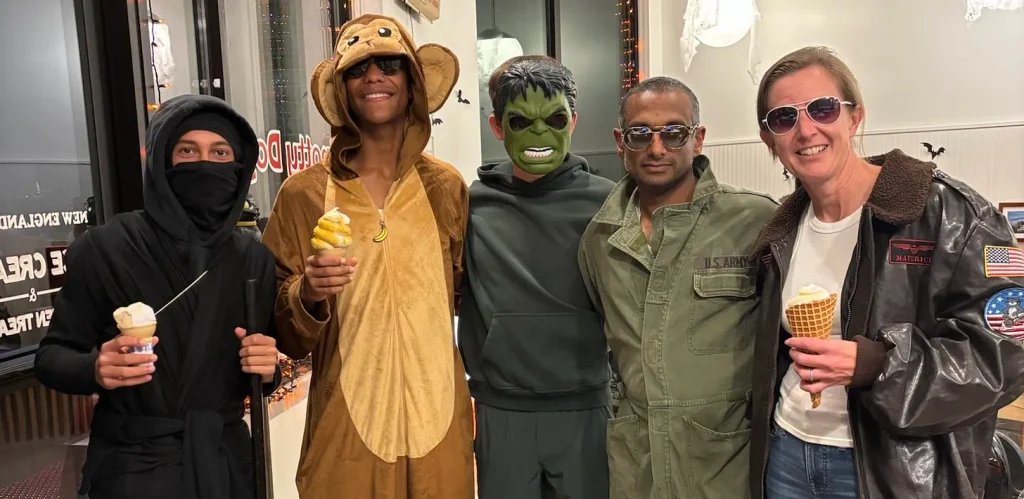
It was a snapshot of his life right now. He’s living with family friends down in Richmond, Virginia as he interns in the Mayor’s office, and the time has not only been a fascinating opportunity to engage in local politics and urban planning. It has also been an invitation into the life of a different family than his family of origin, which has included learning how to cook ramen, watching movies into the wee hours of the morning all together, having parents who dress up in costume on Halloween, and “house church” every Tuesday night.
I share these two moments because they felt like extensions of the essay I wrote for Cognoscenti last week about not wanting my kids—any of them—to become independent. Rather, I want them to become interdependent. So yes, I want them to develop the skills they can manage on their own and take responsibility for their own actions. But I also don’t want to see the areas where they aren’t independent, and where they might never be independent, as categorically negative. I wrote these words (in Small Talk) many years ago, but I’m learning them in a whole new way as our kids grow up and move out of our house:
“Limits, properly understood, are an invitation to love.”
As I wrote in the Cog piece, I have been hesitant to believe interdependence was possible. At first I refused to even consider letting Penny go to college in another state. I thought I was protecting her. I knew how many ways she would never be independent. Eventually, I realized that I fundamentally don’t believe any of us are independent, and I see our lack of independence as a feature, not a bug, of our humanity. That said, we have such an adulation of the idea of independence, of individualism and autonomy, that many of us have forgotten what a society would look like if we actually could depend upon one another.
When I felt afraid to let Penny dream about living in a different state, it wasn’t because I was worried about her independence or lack thereof. Rather, I was worried about networks of care. I was worried that other people — people outside our family — wouldn’t want to help her when she needed help and wouldn’t believe she could contribute to their lives in meaningful ways.
I wrote an essay for the Motherlode blog of the New York Times years ago about our decision not to pursue prenatal testing when I was pregnant with Marilee even though I had a higher than average chance of conceiving another baby with Down syndrome. Hundreds and hundreds of comments ensued, some in full agreement with my position and others denigrating us for the burden we could be placing upon this child’s siblings and upon our social system as a whole if they were to have a chromosomal difference. The comment that struck me the most was from a woman from the Philippines. She said something along the lines of, I am baffled by the question. In my country, when someone comes into the family with needs, the rest of the household takes care of those needs. That’s true when people get sick or old too. Why wouldn’t you just assume that the rest of the household gives whatever care is needed?
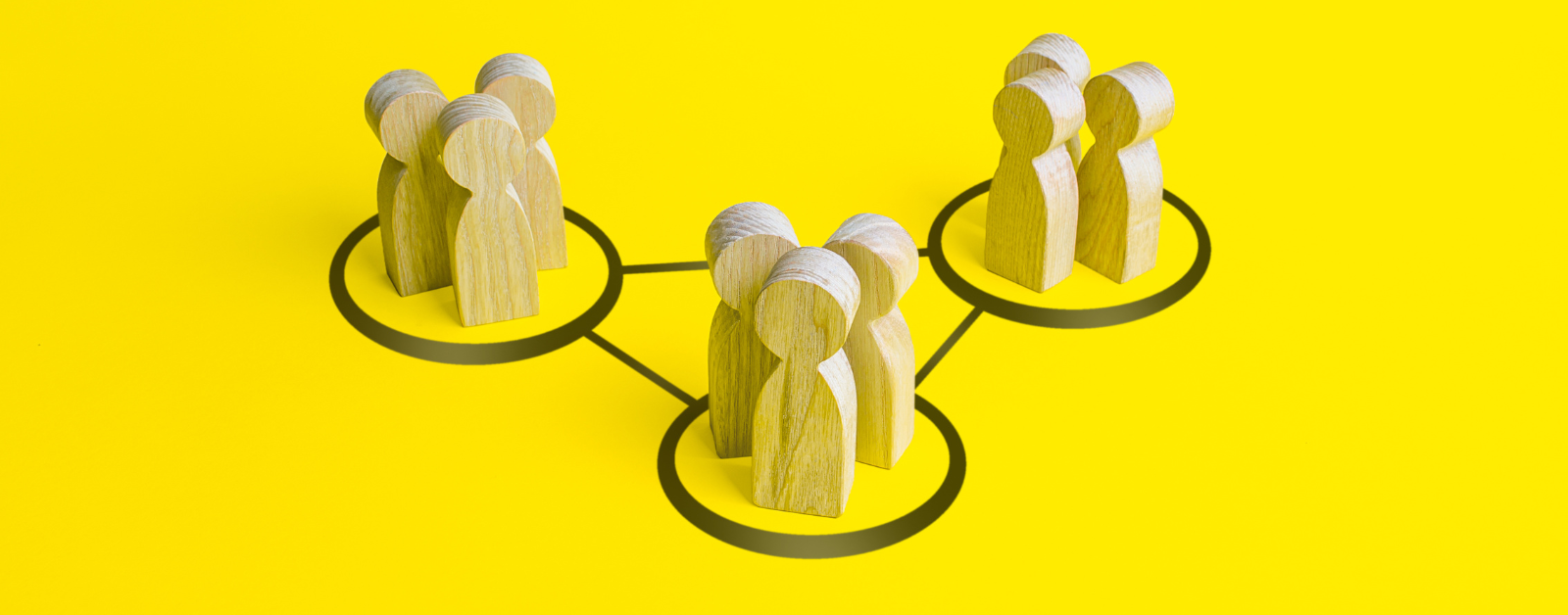
I suspect one of the reasons we have forgotten how to depend on one another is that we are placing too much of the responsibility for care on individual nuclear family units rather than on households and kinship networks, neighborhoods and faith communities. In March 2020, David Brooks wrote a cover story for The Atlantic titled, “The Nuclear Family was a Mistake.” He wrote about the evolution of the American family throughout the 20th century, which he describes as moving “from big, interconnected, and extended families, which helped protect the most vulnerable people in society from the shocks of life, to smaller, detached nuclear families (a married couple and their children).”
Brooks also offered a counter-vision of human community that reaches back through the ages: “for vast stretches of human history people lived in extended families consisting of not just people they were related to but people they chose to cooperate with.” In other words, humans developed as interdependent, not only within biological families, but within larger communities.
I remember learning (though, I’m sorry to say I can’t remember where exactly I learned this!) that the word “household” in the Bible doesn’t refer to a nuclear family. It refers to 60-70 people who live in an interdependent social network. Those households often perpetuated what we would now call oppressive and hierarchical social structures. But they also assumed giving and receiving of care. And those households did not assume that you only belonged if you were biologically related to one another, or if you fell into a certain age category.
As I think especially about Penny’s future, I think about the need for a new imagination around how we structure our living situations. I think of places like Friendship House, an inter-ability housing model. Or Amber Grace, a new inter-ability intentional community. I think about kids growing up with biological or adoptive parents alongside other moms and dads who can teach them things they would never learn from their nuclear family. I think about programs that intentionally integrate elderly women and men with kids in kindergarten, like Ebenezer Ridges in Minnesota. We are made to be interdependent, and we need to structure our family life and communities to reflect our mutual need.
Where have you seen interdependent communities? What would it take for us to reimagine family and civic life to reflect our need for interdependence?
I’d love to hear your thoughts!
SUBSCRIBE to my Substack newsletter: amyjuliabecker.substack.com
JOIN the conversation on Instagram: @amyjuliabecker
LISTEN to my podcasts: amyjuliabecker.com/shows/
CONNECT on YouTube: Amy Julia Becker on YouTube
Amy Julia Becker desires to challenge assumptions about the good life, proclaim the inherent belovedness of every human being, and help us envision and build a world of belonging where everyone matters. Amy Julia invites people to reimagine the good life through her writing and speaking on disability, faith, and culture. She is the author of several books, including To Be Made Well, White Picket Fences, Small Talk, and A Good and Perfect Gift. She is a guest opinion writer for national publications and hosts two podcasts: Take the Next Step and Reimagining the Good Life. Becker is a graduate of Princeton University and Princeton Theological Seminary (MDiv). She is a member of the Disability Ministry Network and the Alliance for Disability Justice and Ethics in Reproductive Genetics. She lives with her husband and their three children in western Connecticut.