I still remember the early days after Penny’s Down syndrome diagnosis, when I wondered what kind of life we were entering. Would our home become a place defined by fear and loss, or something else entirely?
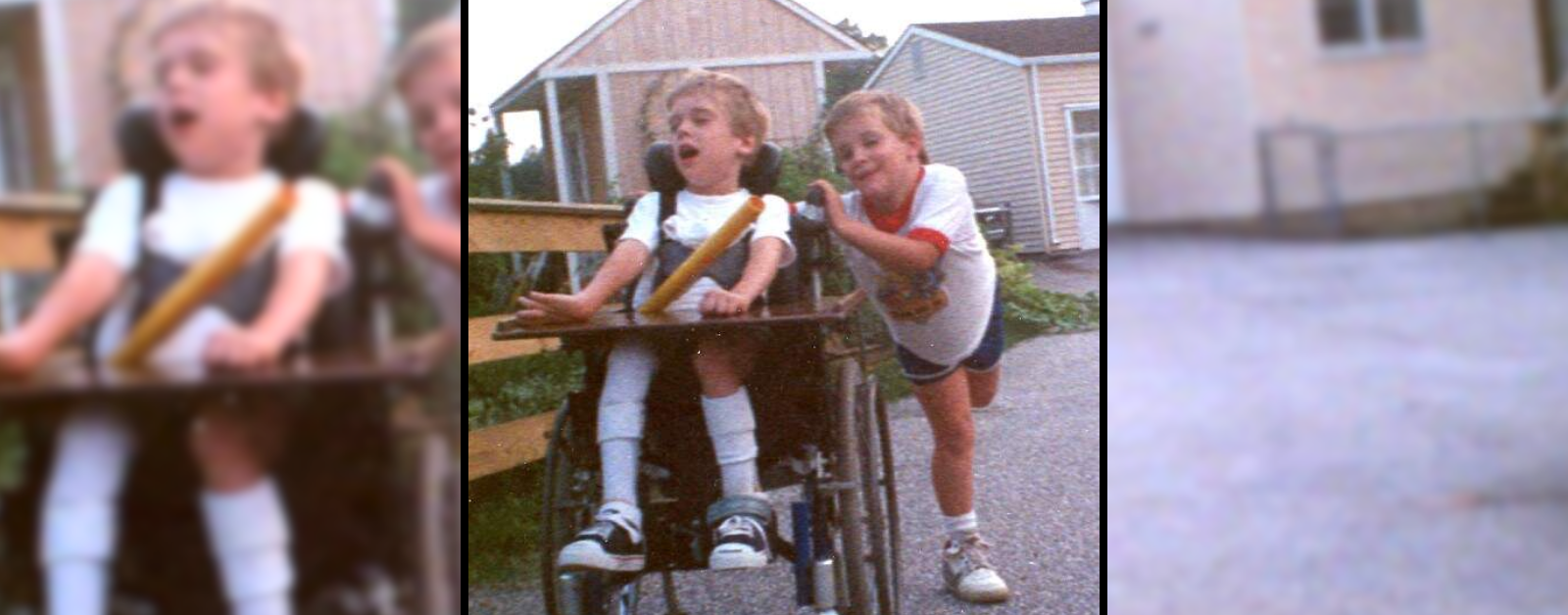
Years later, author Brian Trapp talked with me about his experience growing up with his twin brother who had cerebral palsy. “That was not a house of sadness,” he said. Here are some of the insights Brian shared in our recent conversation:
1. Disability shapes families through relationship, not just hardship.
Brian describes growing up with his brother Danny as an experience filled with caregiving, humor, friendship, and deep connection. Disability transformed his family life in ways that were both challenging and profoundly meaningful.
2. The “glass child” label tells only part of the story.
While the term validates the real struggles siblings can experience, Brian argues it overlooks the gifts, growth, and complexity of sibling relationships and wrongly places blame on parents instead of addressing society’s lack of support. Inaccessible systems and inadequate resources create many of the burdens families face. (A glass child refers to the sibling of a person with a disability or chronic illness whose own needs are often overlooked because family attention is focused elsewhere.)
3. “That was not a house of sadness.”
Homes shaped by disability are often filled with laughter, creativity, love, and ordinary family life, not defined primarily by sorrow or sacrifice.
4. Mental age comparisons can reduce a whole person to a number instead of recognizing the fullness of their life and relationships.
Psychological evaluations often assign a “mental age,” a label that fails to capture the complexity of each individual. Brian recounts how his brother was a man who had deep relationships and the ability to interact with people in ways that far exceeded what any test score could measure.
There’s more in our conversation: Love, Guilt, and Care: A Sibling’s Disability Story with Brian Trapp 🎙️Reimagining the Good Life with Amy Julia Becker • S10 E9
SUBSCRIBE to my Substack newsletter: amyjuliabecker.substack.com
JOIN the conversation on Instagram: @amyjuliabecker
LISTEN to my podcasts: amyjuliabecker.com/shows/
CONNECT on YouTube: Amy Julia Becker on YouTube
Amy Julia Becker desires to challenge assumptions about the good life, proclaim the inherent belovedness of every human being, and help us envision and build a world of belonging where everyone matters. Amy Julia invites people to reimagine the good life through her writing and speaking on disability, faith, and culture. She is the author of several books, including To Be Made Well, White Picket Fences, Small Talk, and A Good and Perfect Gift. She is a guest opinion writer for national publications and hosts two podcasts: Take the Next Step and Reimagining the Good Life. Becker is a graduate of Princeton University and Princeton Theological Seminary (MDiv). She is a member of the Disability Ministry Network and the Alliance for Disability Justice and Ethics in Reproductive Genetics. She lives with her husband and their three children in western Connecticut.