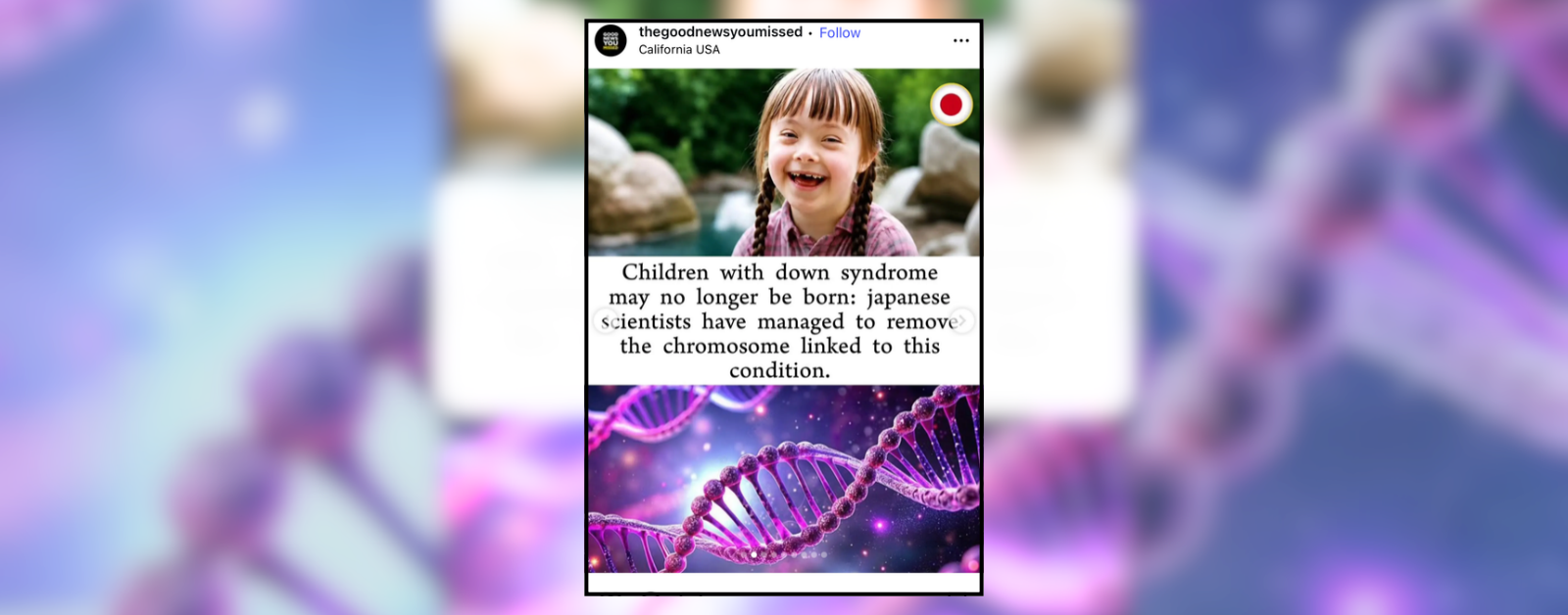
Okay, so tell me what comes to mind when you read the words, “Children with Down syndrome may no longer be born.”
Here’s what those words bring up for me: eugenics. Dystopian fiction. Various European countries who are missing out on beauty and goodness in the name of progress.
What I don’t think is: good news.
And yet, the Good News You Missed Instagram account posted exactly this sentence last week.
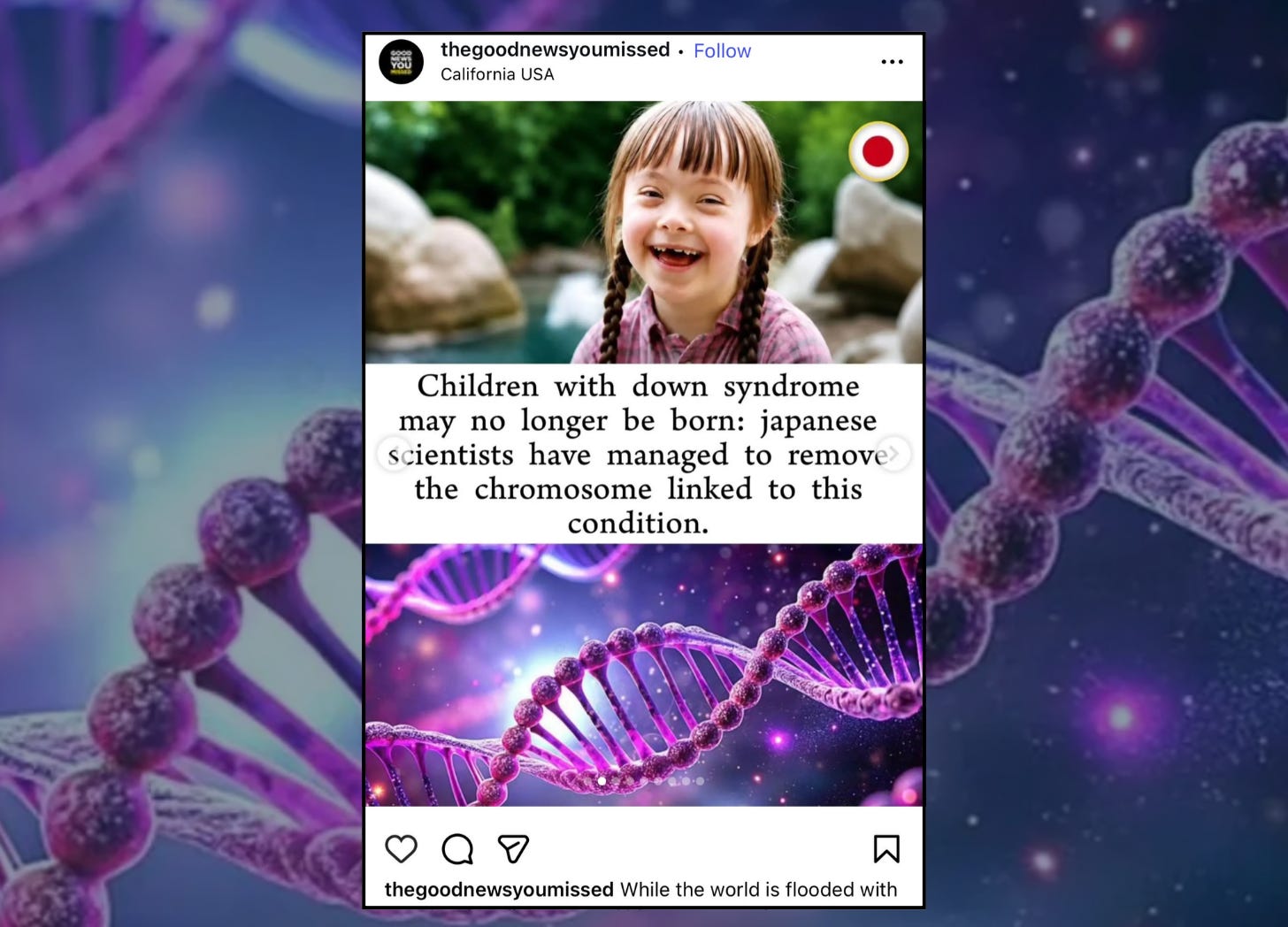
Ironically—tragically?—they also posted this message near the start of Down syndrome awareness month. And they did so accompanied by the smiling face of a beautiful young girl with Down syndrome.
Here’s the thing. The people who run this account really think that it is good news that researchers could remove the extra chromosome that constitutes Down syndrome. They think that people with Down syndrome would still be fully themselves without the presence of a problematic extra chromosome. I believe they mean well. And I believe they are gravely—horrifically—mistaken, in two different ways.
2 Mistakes About This “Good News”
One, while they seem to assume that people with Down syndrome are precious, beloved, valuable and good (which they are), they also seem to assume that Down syndrome itself is categorically and entirely tragic. They think that the person exists outside of the extra chromosome, so to remove the extra chromosome is to remove the problem, not the person. The problem with that reasoning is that anyone conceived with Down syndrome has that extra chromosome in every cell of their body. There is no way to extricate that chromosome without extricating personality and appearance and limitations and gifts. There is no way to isolate Down syndrome and take it away from the person.
Two, they seem to locate the problems associated with disability within the person with the disability rather than recognizing the role society plays in creating disability. I am entirely on board with research that will help alleviate the progression and/or symptoms of, say, Alzheimer’s disease or childhood leukemia or other diseases associated with Down syndrome. I’m incredibly grateful for the medical progress that allows kids like Penny—who needed heart surgery—to thrive. But let’s be clear that when we only see Down syndrome through the lens of a medical problem, we don’t see Down syndrome—or disability—clearly at all.
As the mother of an adult child with Down syndrome, I do not want to take away Down syndrome. Penny does not exist as a human without her extra chromosome. I want to receive her as beloved as she is—with her kindness and gentleness, and her habits that sometimes infuriate me, and her sincerity and her infectious laugh. I do not want to take away Down syndrome, because to do so is to take away Penny.
Here’s what I hope we can celebrate as good news:
–The day we eradicate the stigma attached to Down syndrome and intellectual disability.
–The day people with Down syndrome are fully welcomed within schools, workplaces, and communities.
–The day people with Down syndrome are seen as contributors to our society.
–The day we can both support and celebrate the lives of humans as we are.
There are as many problems associated with having Down syndrome as there are problems associated with being human. Eradicating Down syndrome does not solve those problems. Providing care in response to health conditions and friendship in response to loneliness does. Accepting ourselves as limited, needy, vulnerable, AND gifted, beautiful, contributors does.
This Down syndrome awareness month, I want to celebrate true good news. That people with Down syndrome exist. That they are beautiful contributors to our life together. That they help me understand what it means to be beloved, gifted, vulnerable, and needy. That they help me understand my own humanity and love that same humanity in those around me.
SUBSCRIBE to my Substack newsletter: amyjuliabecker.substack.com
JOIN the conversation on Instagram: @amyjuliabecker
LISTEN to my podcasts: amyjuliabecker.com/shows/
CONNECT on YouTube: Amy Julia Becker on YouTube
Amy Julia Becker desires to challenge assumptions about the good life, proclaim the inherent belovedness of every human being, and help us envision and build a world of belonging where everyone matters. Amy Julia invites people to reimagine the good life through her writing and speaking on disability, faith, and culture. She is the author of several books, including To Be Made Well, White Picket Fences, Small Talk, and A Good and Perfect Gift. She is a guest opinion writer for national publications and hosts two podcasts: Take the Next Step and Reimagining the Good Life. Becker is a graduate of Princeton University and Princeton Theological Seminary (MDiv). She is a member of the Disability Ministry Network and the Alliance for Disability Justice and Ethics in Reproductive Genetics. She lives with her husband and their three children in western Connecticut.