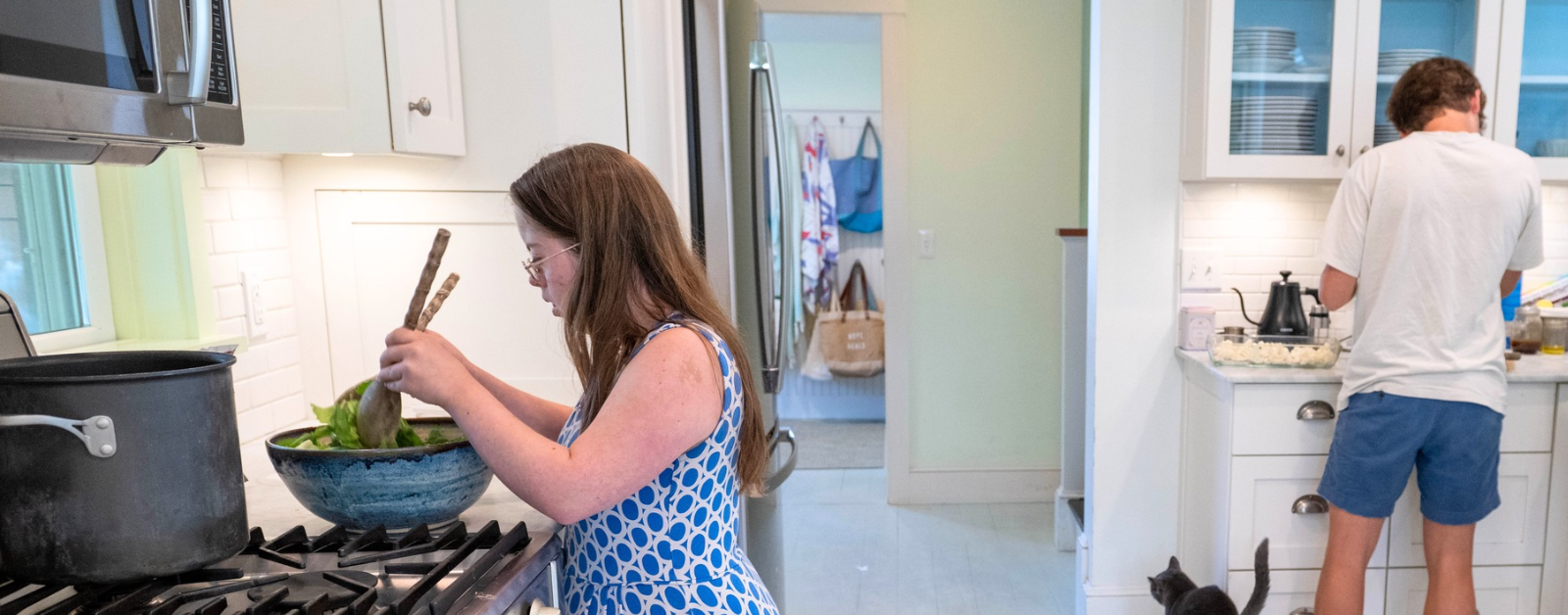
I often write here about life with our daughter Penny, who has Down syndrome. I tell you about her boyfriend, her experiences at work and school, her hopes and dreams for the future. And because she has Down syndrome, sometimes the very ordinary details of Penny’s life seem extraordinary. It’s not the story we expected—an ordinary life, with Down syndrome.
As I’ve been thinking about the ordinariness of her life and of our family’s life, I’ve been wondering whether the experience of disability more broadly can be understood as “ordinary.” On the one hand, so many families experience extraordinary isolation. Some experience deep and ongoing pain—physical, mental, and emotional. Many feel overwhelmed by systems and structures that seem designed to thwart an ordinary existence.
And yet even these severe and extreme hardships point me back to our ordinary humanity as people who have needs, who suffer, and who love.
I’ve written an essay for Praxis Press about the ordinariness of disability. I hope it does nothing to diminish the real and particular needs within the disability community, and I hope it points toward the fact that if we as a society care for and attend to those needs, we are not doing something extraordinary or unusual. Rather, we are returning to our common, ordinary, and beautiful humanity.
“We use the language of ‘special’ needs when describing children with disabilities. And yet, the need for friendship, mobility, housing, meaningful work, agency, love—how unusual are these needs?”
“Becoming a society that values welcome and belonging is more than a matter of justice. It is also a matter of mutual flourishing. If we can welcome people with disabilities, we can welcome the needy parts of ourselves. We can imagine a world where aging is not simply deterioration but a different type of growth and contribution. And we can imagine a society that welcomes children with congenital disabilities as contributors to our common life.”
Read the Full Essay
I’d love to hear your thoughts on whether it’s helpful to think of disability as ordinary.
SUBSCRIBE to my Substack newsletter: amyjuliabecker.substack.com
JOIN the conversation on Instagram: @amyjuliabecker
LISTEN to my podcasts: amyjuliabecker.com/shows/
CONNECT on YouTube: Amy Julia Becker on YouTube
Amy Julia Becker desires to challenge assumptions about the good life, proclaim the inherent belovedness of every human being, and help us envision and build a world of belonging where everyone matters. Amy Julia invites people to reimagine the good life through her writing and speaking on disability, faith, and culture. She is the author of several books, including To Be Made Well, White Picket Fences, Small Talk, and A Good and Perfect Gift. She is a guest opinion writer for national publications and hosts two podcasts: Take the Next Step and Reimagining the Good Life. Becker is a graduate of Princeton University and Princeton Theological Seminary (MDiv). She is a member of the Disability Ministry Network and the Alliance for Disability Justice and Ethics in Reproductive Genetics. She lives with her husband and their three children in western Connecticut.